Isabelle: Tragedy c. 1584
|

Isabelle: Tragedy c. 1584

Auteur prolifique dans un large éventail de genres, Nicolas de Montreux (1561 ?-1608 ?) publie sa tragédie Isabelle en annexe du quatrième volume des populaires Bergeries en 1595. Pourtant la bibliographie de La Croix du Maine atteste que la pièce a été accessible avant 1584, figurant ainsi parmi les premières tragédies de l’auteur, précédant Cleopatre (v. 1592) et Sophonisbe (1601).
Three French Cleopatras 1563, 1578, c. 1592
|

Three French Cleopatras 1563, 1578, c. 1592

These three dramatisations of the story of Antony and Cleopatra constitute a significant sub-genre within sixteenth-century French “humanist” tragedy. Jodelle’s Cleopatra Captive (1553), recognised as the first neo-classical tragedy in French, served as a reference point for subsequent versions by Garnier (1578) and Montreux (c. 1592). Each inflects the dynamic of love and power derived from the classical sources (principally Plutarch) with varying emphases and interpretative possibilities.

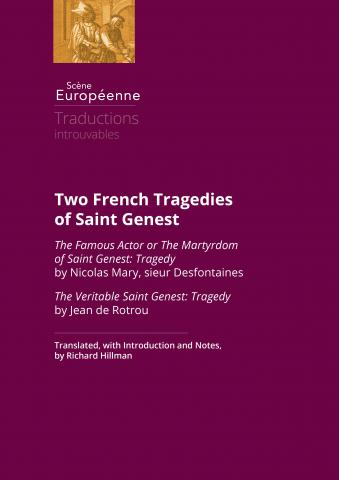
Two French Tragedies of Saint Genest. The Famous Actor or The Martyrdom of Saint Genest: Tragedy by Nicolas Mary, sieur Desfontaines. The Veritable Saint Genest: Tragedy by Jean de Rotrou 1644
|

Two French Tragedies of Saint Genest. The Famous Actor or The Martyrdom of Saint Genest: Tragedy by Nicolas Mary, sieur Desfontaines. The Veritable Saint Genest: Tragedy by Jean de Rotrou 1644

That these two hagiographic plays were virtually contemporary—both created in or around the same year (1644)—bears witness to the attraction of their common subject. The legend of the actor-saint and martyr Genest (Lat. Genesius), which Lope de Vega had previously dramatised in Lo fingido verdadera (pub. 1620), was taking on increased importance in the context of a defence on the Parisian dramatic scene of théâtre dévot and theatre generally.

La Tragédie de sainte Agnès & La Vie et sainte conversion de Guillaume Duc d’Aquitaine (1615, 1632)
|

La Tragédie de sainte Agnès & La Vie et sainte conversion de Guillaume Duc d’Aquitaine (1615, 1632)

TROTEREL, Pierre

Éditées par Pierre Pasquier. Traduites par Richard Hillman

Publié le 07/06/2022Scène européenne, « Traductions introuvables »

Pierre Troterel est un dramaturge du XVIIe siècle trop méconnu. Né probablement en 1586, ce gentilhomme normand est pourtant l’auteur d’une œuvre importante.

The Guisian (1592)
|

The Guisian (1592)

BELYARD, Simon Introduction and Translation by Richard Hillman Publié le 07/10/2019Scène européenne, « Traductions introuvables » It is tempting to dismiss Simon Belyard’s tragedy as a poor cousin of The Guisiade (La Guisiade) of Pierre Matthieu, the other surviving contemporary French tragedy to deal with the assassination of Henri, Duke of Guise, on royal orders at Blois in…

Hector: Tragedy  (1601-1604?)
|

Hector: Tragedy  (1601-1604?)

Hector is widely regarded as Montchrestien’s most accomplished achievement within the conventions of turn-of-the-century neo-classical French tragedy, following in the line of Robert Garnier but with increased distance from any topical political application.  Certainly, on these terms it is a powerful piece of poetic theatre.

The Queen of Scotland (La reine d’Escosse)  (1604)
|

The Queen of Scotland (La reine d’Escosse)  (1604)

MONTCHRESTIEN, Antoine de

Introduction and Translation by Richard Hillman

Publié le 22/10/2018Scène européenne, « Traductions introuvables »

Among the author’s limited dramatic productions over his brief literary career, The Queen of Scotland stood out in its own time, as it continues to do.